
[notice]This article was originally published in the July-August 2007 issue of NGJ Magazine. It has been updated and reprinted in our November-December 2013 issue.[/notice]
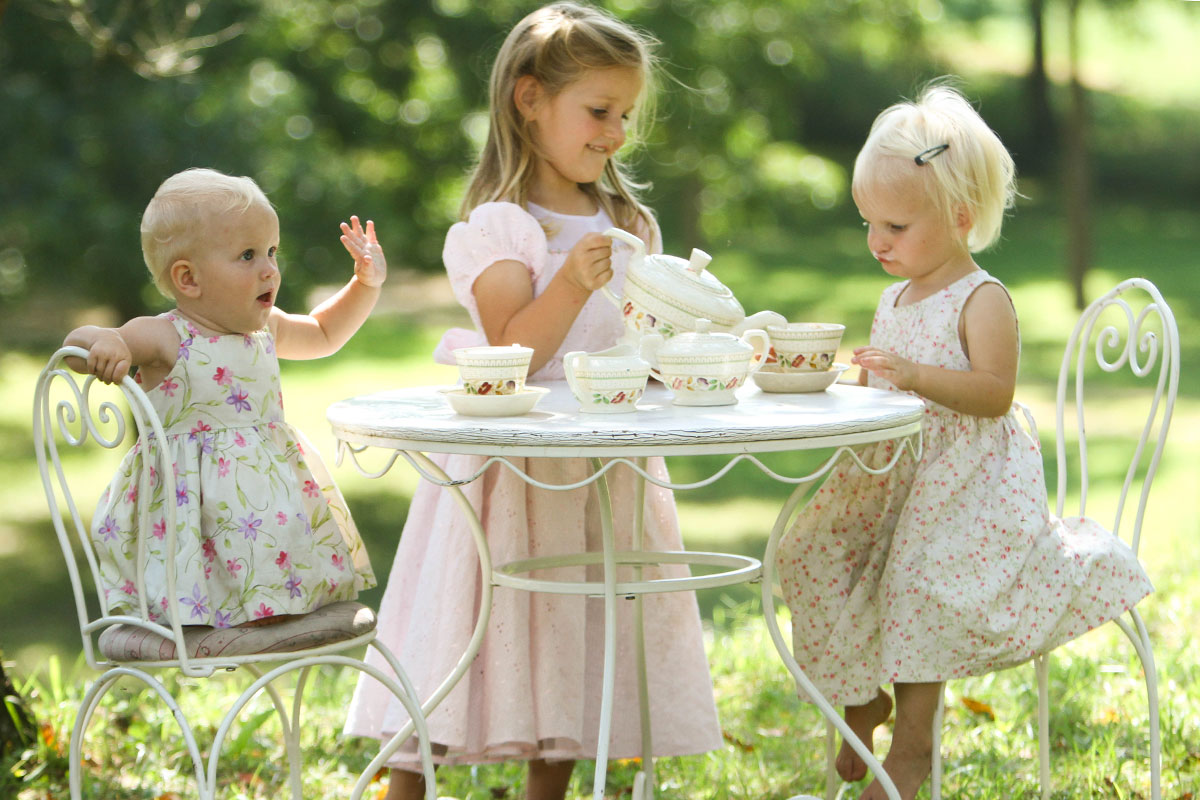
When Joy turned four years old, her birthday requests included a tea set and an apron. Unlike her mother, Joy is the classic “little lady.”
She had multiple miniature tea sets, and although they gave a day’s thrill, Joy was more interested in actually serving the whole family a “real tea time” than just pretending. So we made a trek out to the pole barn and dug out a carefully wrapped 50-year-old box: my great grandmother’s bone china.
Joy carefully helped me unwrap and wash each gold-embossed piece, talking the whole time with utmost excitement about how she was going to serve tea. The pink roses never bloomed so brightly on that china set as they did for Joy. Each day after naps, the girls and I set the table with saucers and cups, creamer and sugar bowls, and fill the teapot with tea. Little china bowls of nuts, fruit, and tiny cookies are set out. Then Joy triumphantly serves tea in her little ruffled apron. Sometimes Daddy and Joe join us. Joy knows how to pour and stir and does it all with a charming giggle.
Now, you should know that Joy is not naturally very attentive or intuitively graceful. She’s actually a bit of a space cadet and is constantly knocking things over, running into walls, and falling off her chair. She is the most bruised and scratched up kid I’ve seen since my sister Shoshanna was little. To watch her set the table with fine china is truly a breathtaking experience, to say the least. But I’ve no intention of taking that china to Heaven with me, and Joy needs something to give her incentive to learn grace and attention. I am not a tea party kind of gal myself.
When I was a girl, my all-consuming interest was reading and writing. I remember my parents driving me all over Memphis to look in every office supply store for a hardcover, lined journal that I could write my stories in.
This was before the journal and diary craze hit the market, and real journal notebooks were impossible to find. I loved those precious lined pages. I used to finger them with pleasure, and put my nose in the white pages to breathe in the clean smell of new paper. It was a sheer joy to write every letter of each word, and I sat for hours thinking up poems and stories so that I could continue to write. It seemed as though my hand craved the feel of the wooden pencil and the detailed motion of each stroke. But just as Joy is not intuitively graceful, I was not intuitively a good writer. I had extreme dyslexia and viewed the world in doubles until I was about four years old. For years, I wrote most of my letters backwards. I remember telling myself to write the letters the opposite of what seemed right so that my story would be readable. In time and with huge amounts of practice, I learned to write my letters without having to double-check myself.
Your daughter may be neither a tea party lady nor a writer, but she surely has a noticeable interest that drives her. She may not be like you in her likes and dislikes, but she is like you in spirit and heart. She needs a mama to provide her with the tools that will enable her to become great at what she enjoys, even if her handicaps seem overwhelming.
Dr. Shinichi Suzuki, the author of one of the best music school theories in the world, tells a story about a little girl with paralysis on one side of her body. This little girl wanted to learn to play the violin. Her crippled arm kept jerking and throwing the bow, and her mother had to pick it up and put it back in her hand again and again. The little girl’s eyes could not focus on the violin for correct fingering. The mother was grieved for her daughter and wanted her to stop trying, but Dr. Suzuki encouraged her to continue. Within six months, the “permanent” paralysis was beginning to fade and the girl could play her first piece of music all the way through without jerking. She became a fine violinist, and her childhood paralysis is now just history.
It’s altogether too easy, upon recognizing our children’s weaknesses and handicaps, to give in to making harmful pronouncements on them: “You’ll never be a good housekeeper,” or “You’ll never be a good driver,” or “You’ll never be a good teacher,” and shut the door on a world of possibilities. Handicaps come and go, as so many true stories have proven down through the centuries. Never assume you know what your child was made for; instead, rightly assume that you were made to beat a path for him or her to find it. It may mean digging out grandmother’s china or driving allover town to find the perfect journal. But take it from me, the struggle is very much worth the finish.
You must be logged in to post a comment.
I have no greater joy than to hear that my children walk in truth. 3 John 4
© 1995–2024. No Greater Joy Ministries (NGJ) is a 501(c)(3) nonprofit ministry of Michael and Debi Pearl.
NGJ is a Member of the Independent Book Publishers Association.





 Church Youth Group


This really struck home for me. My daughter is not great at math. While homeschooling her it was my habit to let her slide on this or that because it was so hard for her and I didn't want her to get discouraged. My husband has a different perspective. He says if its harder for her then she'll just have to work harder. She has learned so much more under his teaching than under mine. It goes back to not proclaiming their future because of their present. Thank you.
My 4 year old daughter has been asking me for several weeks if we could have a tea party with my grandmother's china, that is carefully place on the top shelf and out of reach of little hands. Thanks for reminding me that I won't be taking it to Heaven. We'll be having a tea party tomorrow 🙂
I used to be very cautious as not to allow any of the breakable or the expensive things to be at the reach of my kids.Infact I would even scold them if they try to reach it.Thank you very much for reminding me that I wont take the things to heaven.
What memories this brings back. My daughter went through a period when she was about 7 where she loved to play "shoe store". We made a sign with the name of the store and its hours, we put prices on several pairs of shoes and set up shop. She even had a toy cash register. She loved the game. I however, have always been a busy body, always wanting to get things accomplished. Because of this, I did not spend the time with her playing "shoe store" that I now wish with all my heart I would have. My daughter is now 15 and of course, doesn't want to play "shoe store" anymore. There are other things too that she really got into. Playing waitress, complete with apron, making up menus, prices, and fake money. She was also into "tea time" and pretty tea cups at about 11 years old. I still had not learned my lesson. Again, I did not put the time into those things that I now wish I had. At those times, I felt like she would never grow out of it and that there would always be "another time" to play those games. But I was wrong. I turned and my daughter had grown. I had missed my opportunities- and I will never get them back, not in those same ways. I am glad to see not everyone suffers from my "busy bodyness". My heart breaks when I think of those times. I just hope that I am not currently missing similar opportunities at this point in her life. We have them for such a short while although at the time it seems like it will last forever.
Wow. Thank you for republishing this. I need it now!